
May 7, 1946
Coal Strikes, Boston Anxieties, and a Record Within Reach

May 7, 1946. The last two weeks have been exciting for Red Sox fans, who watched with hope and anticipation as the Old Towne Team chased the franchise record of 15 consecutive wins, set by the 1946 Red Sox. They finally matched it on July 22nd in the first game of a doubleheader against the Baltimore Orioles. As I followed the games from behind my desk, baseball became the backdrop against which my own life unfolded. It was a true Baseball and Us moment. As I listened along, I found myself wondering what my counterparts in 1946 were doing as they followed the last Red Sox team to win 15 straight games in its pursuit of the major league record.
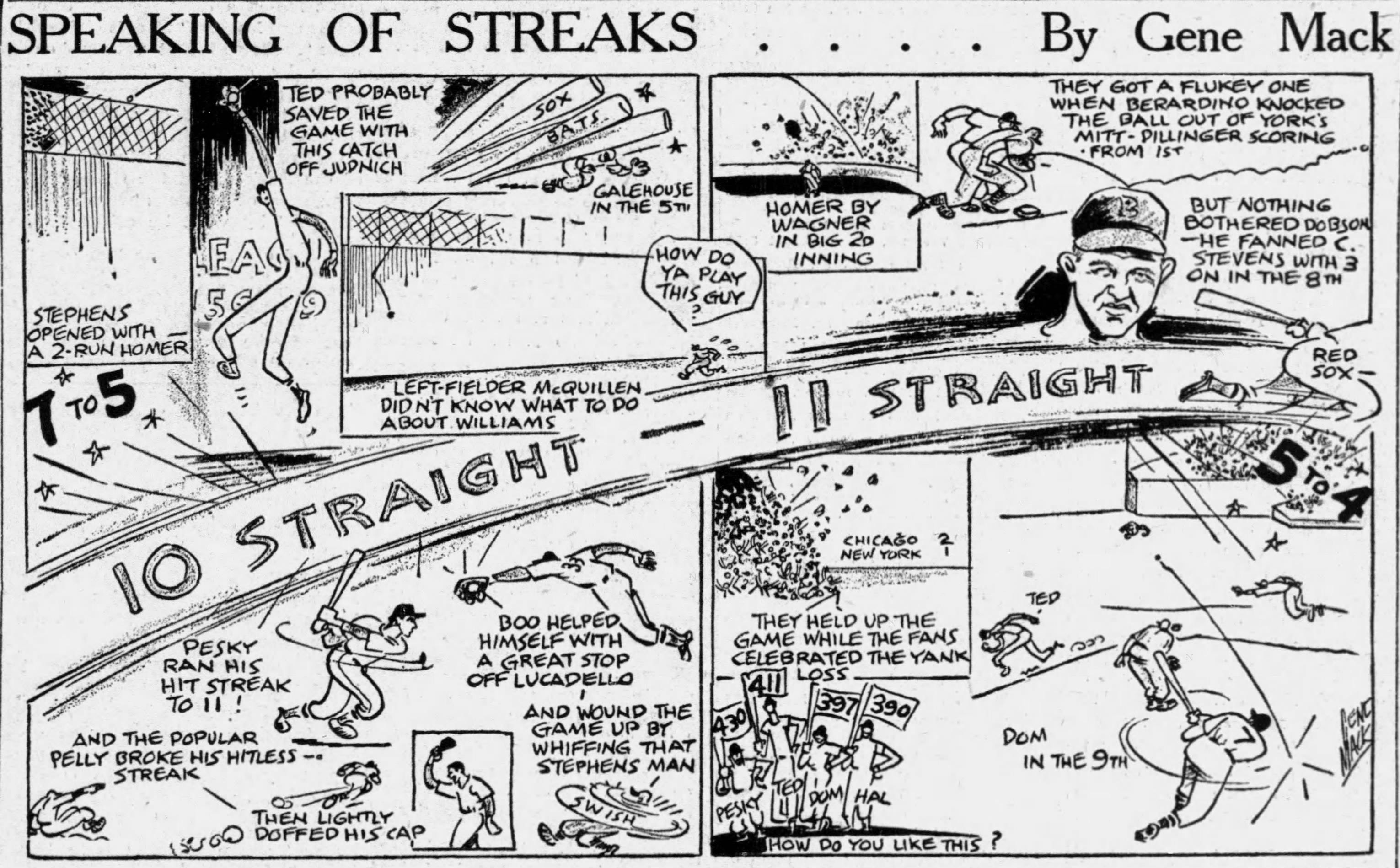
On May 7, 1946, the Boston Red Sox were playing for their 12th consecutive win, a mark that would tie the then-record, set in 1939. And in a bit of symmetry that feels almost too perfect, they were playing the St. Louis Browns, who would relocate in 1954 and become the Baltimore Orioles. Last week, I wrote about the start of the 1946 streak, which you can find here. This week, I ask what Bostonians were doing as the 1946 Red Sox were chasing history.
For many, it was a time of anxiety and uncertainty.
The headlines were dominated by the fallout from the ongoing strike of the United Mine Workers of America, which started on April 1st and saw 400,000 workers walk off the job. By May, the coal shortage was starting to impact the day-to-day lives of people around the country. The Office of Defense Transportation (ODT) had issued orders to cut passenger rail service by 25 percent, forcing the Boston and Maine Railroad to reduce its routes. The ODT had also ordered the cessation of movement of all carnival and circus trains, which led to questions about whether the Ringling Brothers Barnum and Bailey Circus could make it to Boston for the following week’s show. Luckily for parents across New England, the Red Sox were hot, and children interviewed by the Boston Globe said they'd rather spend the week at Fenway than at the circus.
The coal shortage threatened more than rail travel. Many buildings in Boston, including all fire and police stations and most schools, relied on energy provided by burning coal. The New Bedford Cotton Manufacturers Association warned that they would have to shut down all of their plants if the strike was not resolved soon. New Englanders were warned that even if the strike ended immediately, coal may still need to be rationed in the winter.
Even baseball wasn't immune to the coal shortage with the Washington Senators suspending the playing of night games at Griffith Park.
It was also the eve of the one-year anniversary of V-E Day, which marked the surrender of Nazi Germany and the end of World War II in Europe. Celebrations were beginning across New England and Governor Maurice Tobin was set to take part in a V-E Day commemoration exercise at the Naval Hospital in Chelsea.
In positive local news, the Medford School Committee had voted to equalize pay between male and female teachers, abolishing a rule that mandated that male teachers earn $500 more than their female counterparts.
The front page of the Boston Globe also discussed that day’s game and the potential for history to be made. The Red Sox had swept the Browns in a doubleheader the day before. The Red Sox offered their own kind of anxiety, but of a much more benign variety than the coal strike.
At 3:00 PM, baseball fans around Boston tuned into WNAC-AM on the radio. Much like me 80 years later, they followed the game through the narration of a commentator at Fenway Park. Many of them were at work, letting the game play in the background as they conducted their daily lives. The first televised Red Sox game was still almost two years away, so the only way to see the action was to be there, and 11,399 fans were lucky enough to be there in person to watch the Red Sox chase history.
Things did not look good at first. The Browns built a 4–0 lead by the end of the second inning, and Red Sox starter Tex Hughson was chased with two outs in the third. Ted Williams cut the deficit to 4–2 with a home run, but the Browns answered in the fourth to make it 6–2.
The Red Sox started to claw their way back, scoring two runs in the bottom of the sixth inning to narrow it to 6-4 and then two more runs in the seventh inning to complete the comeback and tie the game at 6-6. It was a stroke of good luck for the Browns that the game was tied. The Red Sox had loaded the bases with one out in the sixth inning but were only able to score two.
The game was a nailbiter and the pitchers on both sides began to settle in for what the Globe would call, “tensest relief-pitching duel of the season.”
The game entered extra innings and the tension was high. The game began to extend into evening commutes as people listened to action unfold on their way home. In the fourteenth inning, Leon Culberson came to the plate. Culberson had gotten no hits in five at-bats during the game. He had been inserted into the game in the fourth inning to replace third baseman Eddie Pellagrini. Despite having no hits, he had picked up an RBI in the sixth inning after Rudy York scored on a fielder’s choice. The bases were loaded and nobody was out. Culberson just had to put the ball in play and get it out of the infield to win the game. A sacrifice fly would do the trick.
People gathered around their radios for the seemingly inevitable march to victory. Of course, in baseball, nothing is inevitable. Teams have loaded the bases with no one out and not scored before. But after 14 innings, victory seemed within grasp.
Culberson exceeded expectations and sent the ball out of the park to win on a walk-off grand slam to win the game 10-6. It was a dramatic ending to a nail-biter of a game.
The record was tied. The Red Sox would win three more before losing to the team that started the streak, the Yankees, to end it at 15.
It was a great day at Fenway Park.
When the game ended, people turned off their radios and went back to their lives. Some headed home after work. Others worried about the coal shortage, prepared for the V-E Day anniversary, or wondered whether the circus would make it to town. Life went on as history marched forward.