
April 25, 1946
The Genesis of a 15-Game Winning Streak

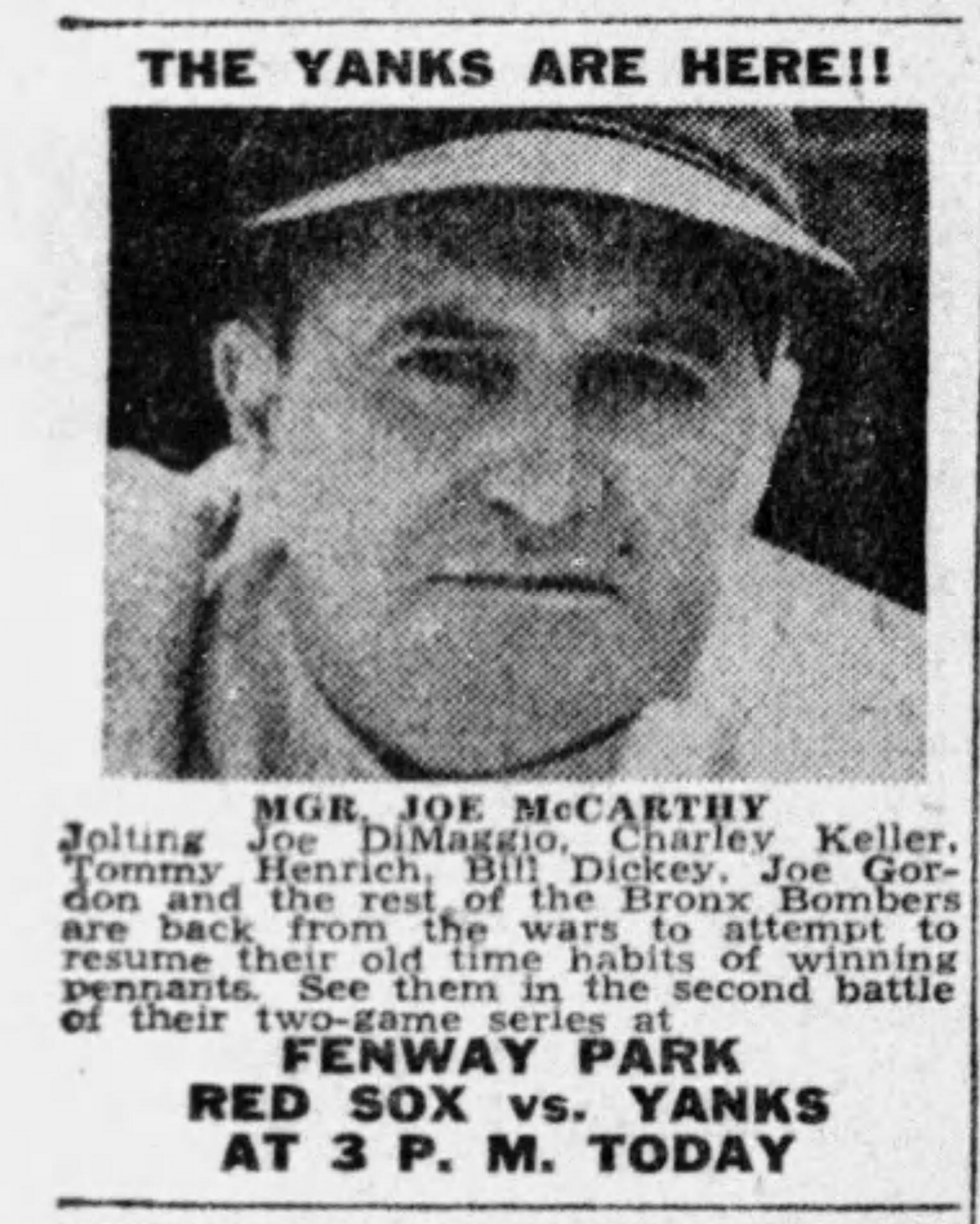
April 25, 1946. As of this writing, the 2026 Boston Red Sox are riding a 13-game winning streak. It’s an incredible turnaround for a team that looked well out of contention just a month ago. It’s also just two games shy of the all-time franchise record of 15 consecutive victories. No one had any way of knowing on July 3, 2026, that the Red Sox’s win over the Los Angeles Angels was the start of a potentially record-setting winning streak. I was sitting in Angel Stadium that night, and I had absolutely no idea what I was witnessing.
What about the people who actually witnessed the start of the longest winning streak in franchise history? My counterparts on April 25, 1946, had the same perspective. Fans turned on their radios or ventured to Fenway Park to watch the Red Sox play the New York Yankees, not knowing they were witnessing the first step in a long march toward history.
Newspaper headlines on the morning of April 25 were dominated by the fallout from World War II and ongoing discussions about Europe’s future. Representatives from the United Kingdom, the United States, the Soviet Union, and France met in Paris to continue negotiations. April 25 marked the first day France was formally included in those discussions. The world awaited their outcome.
Closer to home, the war’s shadow stretched into Boston courtrooms. The Boston Globe reported on the trial of a Somerville doctor and two accomplices accused of taking money to fabricate medical conditions for men hoping to avoid the draft. One father testified that he paid $1,200 for paperwork claiming his son had flat feet.
Organized crime made its way into the paper as well. Rhode Island authorities were investigating the murder of Jack Letendre, director of the Narragansett horse racing track, who had been found shot in his car near his home in Woonsocket. An informant suggested the killing was tied to a Florida gambling syndicate angered over unpaid winnings. Letendre had been seen speaking with unidentified men at the Blackstone Hotel, which he owned, on the night of the murder, but police cleared all of the hotel’s guests. It was the kind of story that felt ripped from a movie, except it was unfolding just down the road.
Gallup also released the results of a national poll asking whether Americans preferred year-round standard time or daylight saving time. Only 19 percent of respondents favored year-round daylight saving time, 31 percent wanted it only during the summer, and 45 percent preferred standard time year-round. Five percent had no opinion.
Boston’s civic leaders were also debating how to address the city’s growing traffic problems. One proposal called for building a parking garage beneath the Boston Common so people could park downtown and go about their business. At the time, the idea was considered far-fetched.
If fans wanted to catch a movie after that day’s game, they could have gone to see the newly released Western “The Virginian”, starring Joel McCrea in the title role. The film was presented in Technicolor, still a marvel in its day. It was showing at both the Paramount and Fenway theaters, which were owned by Paramount Pictures, the studio that produced the film.
The Paramount Theatre survives today in the Theater District as part of Emerson College while the Fenway Theatre was purchased by Berklee College of Music in 1972 and survives today as the Berklee Performance Center.
Fans arrived at Fenway Park for an afternoon game fresh off a 12-5 loss to the Yankees in the series opener, a game in which Ted Williams, playing his first season after returning from military service in World War II, grounded into three double plays. The Red Sox entered the day 6-3, with five of those victories coming during a season-opening winning streak.
It was a beautiful New England spring day with temperatures ranging from the upper 50s to the mid-60s. A crowd of 31,150 settled in to spend a Thursday afternoon watching Ted Williams and Bobby Doerr face Joe DiMaggio and Phil Rizzuto. Contemporary newspaper reports claimed it was a record attendance for a weekday game at Fenway Park. It was classic Red Sox-Yankees.
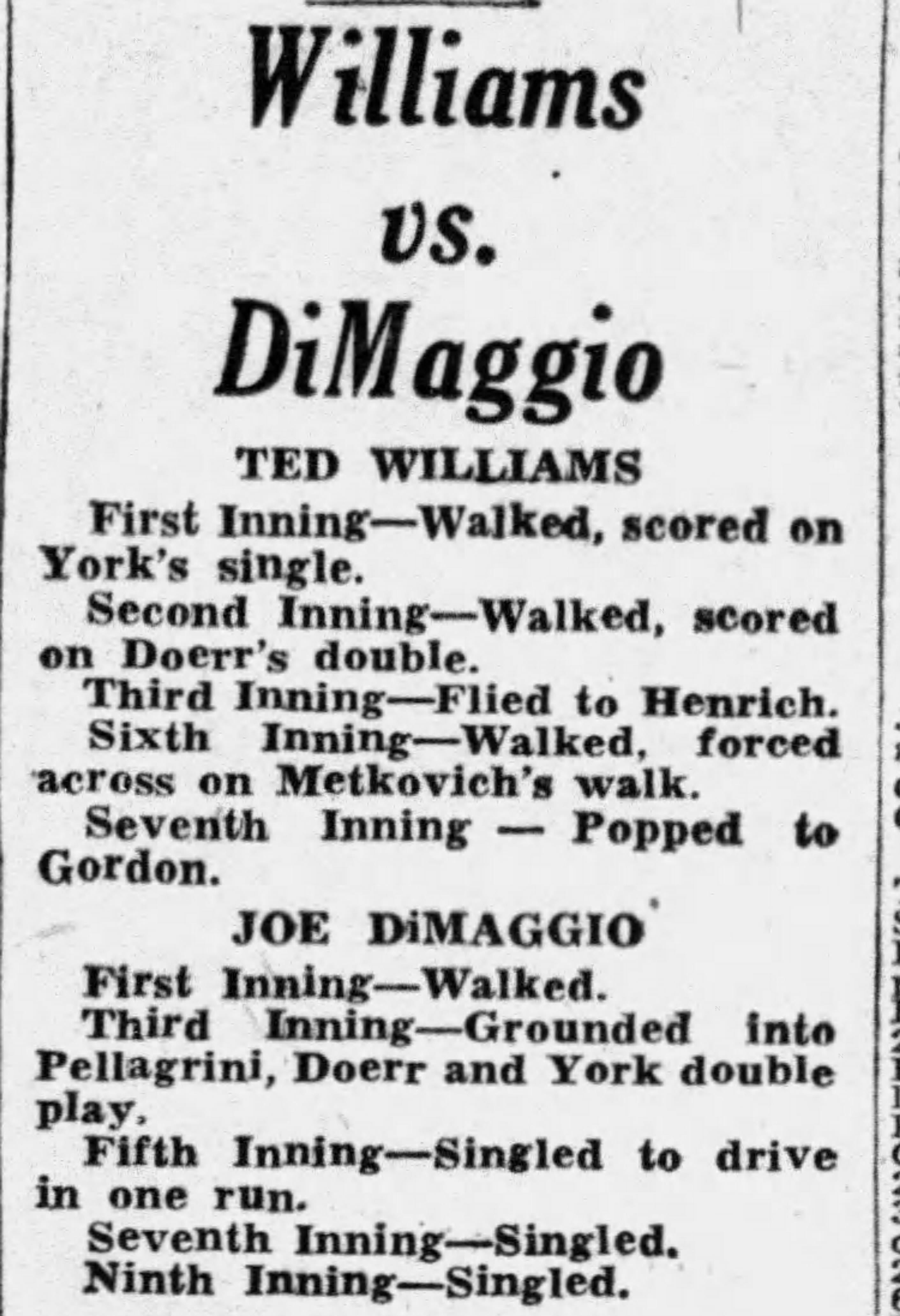
The Yankees had gotten off to a strong 7-2 start to the season. Their fast start, however, contrasted sharply with the way they opened this game. Steve Roser took the mound for New York, but he was there for neither a long time nor a good time. In an era when starting pitchers routinely worked deep into games, Roser was pulled with two outs in the first inning after surrendering a triple to Eddie Pellagrini that scored Rudy York with Boston’s fourth run. It was a stunning collapse after the Yankees had jumped out to a 2-0 lead against Red Sox starter Joe Dobson, whose erratic first inning included three walks, one of them with the bases loaded.
The Red Sox did not let up against Roser’s replacement, Bill Zuber, scoring three more runs in the second inning. They added two more in the third to build a 9-2 lead. From there, the Yankees never seriously threatened to get back into the game. Dobson settled down and pitched a complete game, allowing five runs in a 12-5 Red Sox victory.
It was a heck of a way to begin the longest winning streak in franchise history. The streak lasted until May 11, when it ended with a 2-0 loss to the Yankees in the Bronx. It helped propel the Red Sox to the World Series, where they ultimately fell to the St. Louis Cardinals. Whether history will repeat itself in 2026 remains to be seen.