
September 30, 1982
Cheers Opens Its Doors and the Brewers Can't Close Their Tab

September 30, 1982. The Red Sox season is sunsetting at Fenway Park, a team that once led the division by five games now playing out the string and watching the Milwaukee Brewers close in on a pennant that won’t belong to Boston. It feels familiar, another summer that began with hope and ended in heartbreak, another September where the Fenway Faithful could only wait for the season to end.
But a few blocks away, inside a bar on Beacon Street, something else is beginning. A former Red Sox reliever is wiping down the counter. A graduate student has just been left by her fiancé. And before the night is over, Boston will have two stories to tell, one about baseball heartbreak, and one about a place where everybody knows your name.
At least the heartbreak wouldn’t belong to the long out of contention Red Sox. They had been contenders early, even leading the American League East by five games in late June and last holding sole possession of first place on July 30. After that, it was .500 baseball through the dog days, and a 13–15 September that knocked them out for good.
The division was down to two teams: the Milwaukee Brewers and the Baltimore Orioles. Boston was nine and a half games back, spectators. Milwaukee led by four with five to play, with a season-ending showdown against Baltimore looming. They had already taken the first two games at Fenway. Their magic number was two. Win that night, get an Orioles loss in Detroit, and the East would be decided before the final series even mattered.
At 7:30, Bostonians could turn to Channel 38 to watch the Red Sox try to delay the inevitable. If you preferred the radio, you found WITS on the dial.
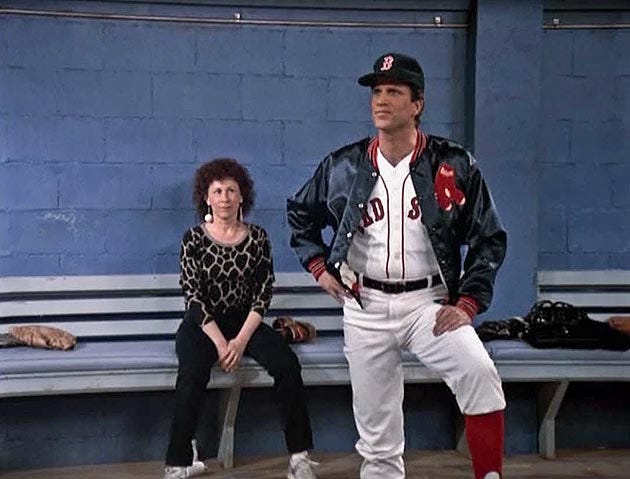
At 9:00, Channel 4, NBC in Boston, introduced viewers to a new sitcom set in a bar run by a recovering alcoholic and former Red Sox pitcher. A Boston University graduate student walks in for a drink. Her fiancé, who is also her boss, leaves her that very night to return to his ex-wife. By the end of the episode, she has a job behind the bar, thanks to an uncanny ability to remember drink orders.
That show was Cheers. And it would run for 11 seasons. Though it actually did not have much initial success, finishing 74th of 77 shows in the 1982–1983 television season.
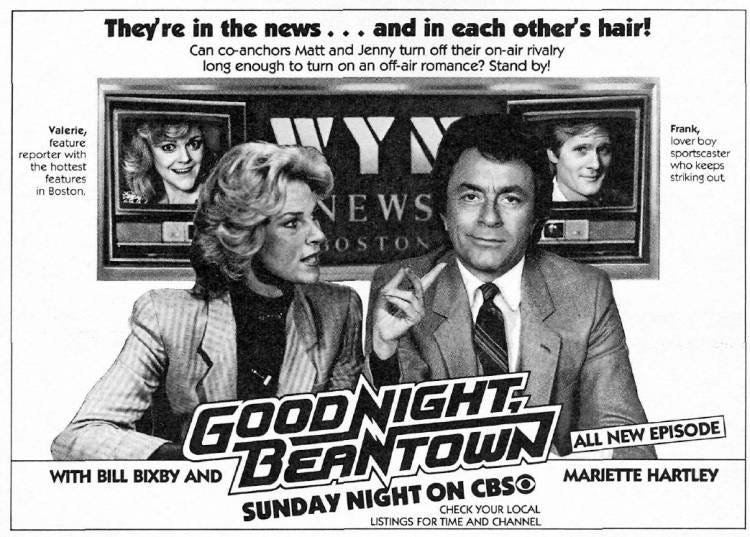
In fact, it was not the only show set in Boston to premiere during the 1982-1983 TV season. Goodnight, Beantown premiered on CBS in the spring to rave reviews from the Boston Globe, who rated it even higher than Cheers. It lasted 18 episodes, the last of which aired on January 15, 1984. It was the first big role for Tracey Gold, who would go on to bigger fame as Carol Seaver on Growing Pains.
If you flipped to Channel 5, you could catch the premiere of Joanie Loves Chachi. The less said about that, the better.
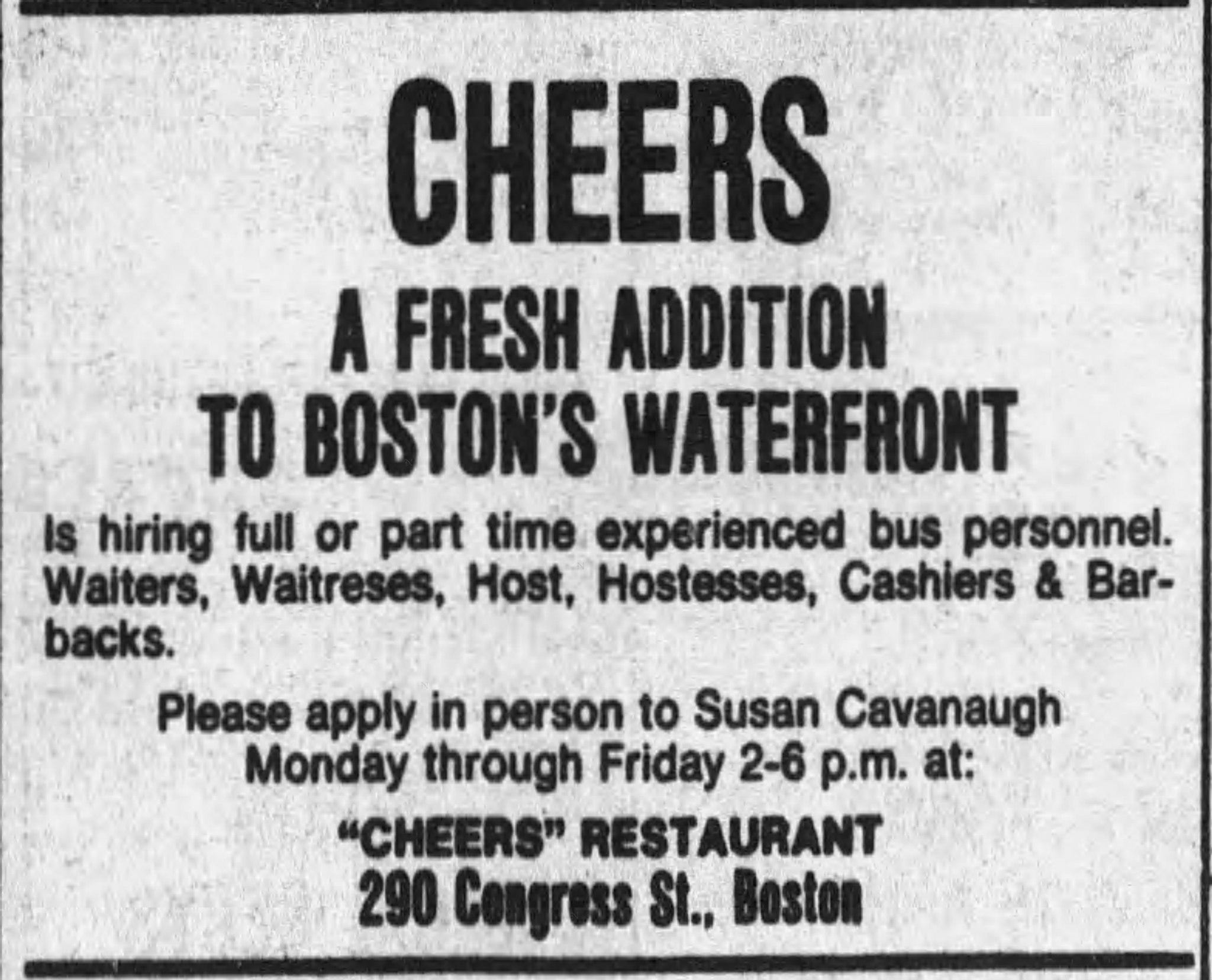
I would be remiss if I did not mention that a restaurant with the name “Cheers” did open in Boston in 1982. While it’s well known that the exterior for the fictional Cheers bar was the Bull & Finch Pub on Beacon Street, there was also a real restaurant by the same name that opened in the Waterfront District at 290 Congress Street.
By November, the bar was being advertised as “Three Cheers,” and it remained open until at least the mid-2000s. The site is now part of the Atlantic Wharf mixed-use development.
Before we get to the box score, we need to understand the country on September 30, 1982.
Ronald Reagan was in his second year as president, facing midterm elections in an economy with double-digit unemployment. A New England Council study found the region led the nation in job losses during the first half of the year.
The United States government teetered on the edge of a funding lapse, and the events of September 30 unfolded as lawmakers worked to pass a funding bill. Unlike today, however, this delay was not a game of political brinkmanship. It was simply because of other priorities. Republicans attended a barbecue organized by the President while Democrats held a fundraising dinner.
The NFL was in the middle of its first in-season strike, nine days old and destined to last 57. The need to fill time prompted CBS Sports to ask Bowdoin and Bates Colleges in Maine to reschedule their home games for the following weekend from Saturday to Sunday to accommodate its broadcast schedule. Both schools declined the offer due to competing priorities.
In Massachusetts, a bitter Democratic gubernatorial primary had just concluded, and former governor Michael Dukakis had unseated incumbent governor Edward King. His running mate was Vietnam veteran John Kerry, who had won the lieutenant gubernatorial primary. Both men would be successful in that November’s election, though not in their eventual runs for the presidency. The Boston Globe estimated that King and Dukakis spent $4.99 per vote cast in the primary.
If you were listening to the radio on September 30, 1982, you might have heard these songs. The top five that week, courtesy of Casey Kasem’s American Top 40:
And if you went to the movies that week, you might have seen:
An Officer and a Gentleman
E.T. the Extra-Terrestrial
Zapped!
Fast Times at Ridgemont High
The Best Little Whorehouse in Texas
If you went to the ballpark, it was a cloudy, brisk New England fall night at Fenway Park, 21,268 fans in attendance, the Red Sox trying to avoid a sweep and the Brewers trying to clinch the American League East. Boston sent ace Dennis Eckersley to the mound. Milwaukee, with its division fate within reach, started Jim Slaton, who was working so the Brewers could save their better arms for the next day’s doubleheader in Baltimore.
Eckersley looked sharp from the first pitch. The Red Sox had their first scoring chance in the bottom of the first. Carl Yastrzemski’s two-out single put Jim Rice on third, but the Brewers escaped when Carney Lansford flew out.
Boston kept testing Slaton early. In the second inning, Rick Miller reached on a single and quickly stole second. With two outs and runners in scoring position, the Red Sox still could not push a run across.
But in the third inning, things broke open. With the score still tied, Boggs, who had scuffled in recent weeks but was still batting over .340, delivered a double to left to score Rice, putting Boston up 1–0.
Boston was not done. In the fourth, after a walk and a sacrifice, Dwight Evans doubled to left center to score a run. Rice followed with an RBI single to make it 3–0. That chased Slaton and brought in reliever Jamie Easterly, but the Red Sox offense kept coming. Wade Boggs added another RBI single, and Boston led 4–0.
Through the middle innings, Eckersley continued to stifle Milwaukee’s powerful lineup, the so-called “Harvey’s Wallbangers.” Three straight singles in the sixth set up a sacrifice fly by Boggs and an RBI single by Miller, pushing the lead to 6–0 and dimming Milwaukee’s hopes of clinching that night.
In the seventh, with the Brewers unable to score, the Red Sox kept the pressure on. Evans homered to make it 7–0.
Milwaukee did make a late charge in the eighth. Paul Molitor hit a two-run homer. Cooper followed with another two-run shot, and suddenly it was 7–4. But Eckersley’s night was done, and Bob Stanley came on in relief. Stanley kept Milwaukee at bay, retiring dangerous hitters and preserving the lead.
Boston added insurance in the bottom of the eighth when Tony Pérez hit a pinch-hit two-run home run, making it 9–4. Stanley returned in the ninth and closed the game.
But there was one more twist. In Detroit, the Orioles rallied for a four-run ninth inning and beat the Tigers. That meant the Brewers would not clinch the division that night. They now needed just one win against Baltimore to secure the AL East.
So while the Red Sox were long out of contention, they played spoiler on this chilly Boston night, sending the Brewers into a final series showdown for the division crown.
At Fenway, a fading season stretched the pennant race one more day. And on Channel 4, a bar opened its doors and stayed open for eleven years.