
September 11, 1918
The Last Hurrah Before the Drought

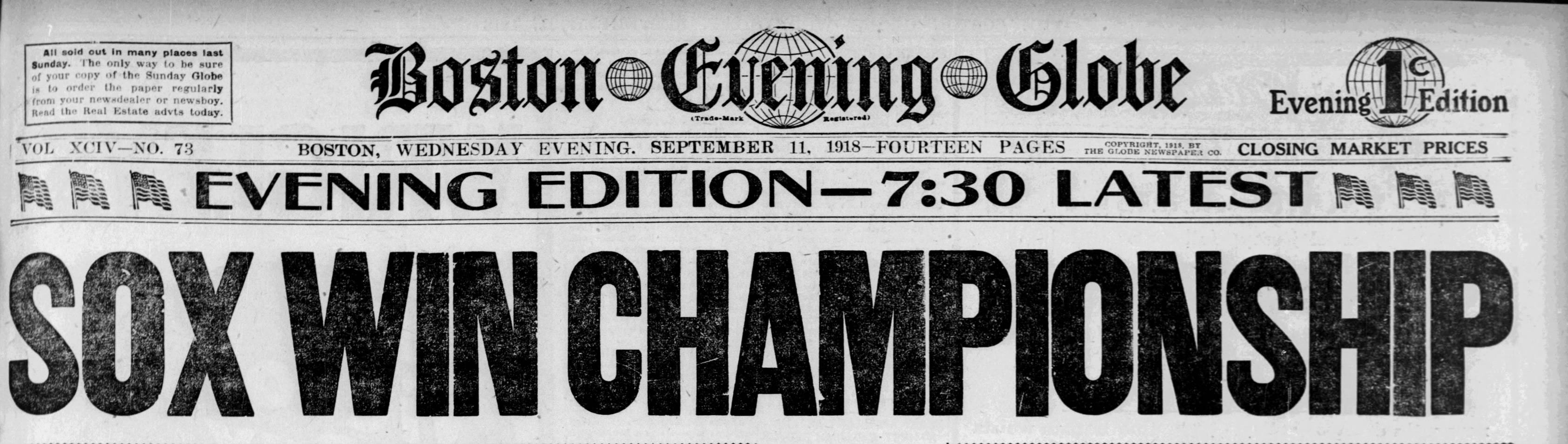
September 11, 1918. I am making this week’s posts from the Windy City, Chicago! As I am sitting here, I am thinking about the 1918 World Series and the jubilation that followed the Red Sox winning their fifth championship in the first 15 World Series. It was a level of dominance that would make one think that the good times would last forever. However, I would imagine that the majority of people reading this piece know what happened next.
Why am I thinking of 1918? Well, the Red Sox defeated the Cubs, who were ten years into what would become a 108-year dry spell. My trip to Chicago was to include a tour of Wrigley Field, which was already the home of the Cubs by 1918. An unexpected flight delay pushed those plans to another time. Of course, the Chicago portion of the World Series was played at Comiskey Park, home of the White Sox. It was not uncommon for crosstown rivals to play in the other team’s stadium if the other stadium had a larger seating capacity. The Red Sox had played the 1915 and 1916 World Series at Braves Field. They had returned to Fenway Park for the 1918 World Series.
No one who went to Fenway on that September day had any way of knowing that they were seeing something that the vast majority of them would never again see in their lives, a Red Sox World Series win. 86 years came and went before it happened again. People were born, lived full lives, and died without ever seeing their favorite team win it all. For over eight decades, the green trees of summer turned into the colorful canopies of fall, which turned into another winter of disappointment. The gentle New England snowfall was heavy with the wishes of generations of fans that just wanted a taste of World Series glory.
On September 11, 1918, the country was grappling with the First World War, which had forced the Major League season to a premature end. The federal government’s “work or fight” order required men of draft age to find work considered essential to the war effort or risk military service. Playing professional baseball did not qualify.
The war dominated the headlines, with stories from Europe filling the pages of the Boston Globe. In an era before television and mass radio broadcasting, the newspaper was one of the primary ways Americans followed a war being fought thousands of miles away.
The expansion of the draft was also front-page news. Less than two weeks earlier, the Selective Service Act had been amended to expand draft registration to men between the ages of 18 and 45. The original 1917 registration had covered men ages 21 through 30. The new group was expected to register the next day, September 12th. In 1918, that meant showing up in person, and the Globe devoted considerable space to telling readers where and how to register.
The news of a Boston and Maine Railroad passenger train accident in Dummerston, Vermont, which had claimed the lives of three people and injured 22, was also front-page news. It was a reminder that tragedy was not confined to the war in Europe.
Speaking of Vermont, the nomination of Percival Clement for governor by the Republicans there was also front-page news in Boston. Clement’s nomination highlighted the ongoing debates about the prohibition of alcohol, which he opposed. His position differed from the majority of elected officials in Vermont.
He had benefited from a divided field, winning the Republican nomination with just 36.5 percent of the vote. In the end, however, that relatively narrow plurality mattered little. Vermont was so reliably Republican at the time that securing the party’s nomination was, for all practical purposes, tantamount to winning the general election.
To this point, 14 states had ratified what would later become the 18th Amendment to the United States Constitution. Vermont was still a holdout.
It was also an unseasonably cold day across much of New England, marking an unusually early arrival of winter weather. Temperatures as low as 26 degrees were reported in Manchester, New Hampshire and Northfield, Vermont. The mercury hovered around the freezing mark in the immediate Boston area. The Evening Globe reported that people close to Boston woke up with a white coating of frost on the ground. The fans who were heading to Fenway Park would have to bundle up.
Against all of this, there was also a World Series being played.
The war had shaped the Series before either team took the field. In an effort to reduce travel, the first three games were played in Chicago, with the remaining games scheduled for Boston. That meant the Red Sox and Cubs would make only one trip between the two cities. After Game Three, they spent Sunday traveling east and arrived in Boston the following day, not long before Game Four was scheduled to begin.
There had not been much offense to speak of, which was fairly typical of the deadball era. Boston won the opener 1-0 behind a shutout from Babe Ruth, Chicago answered with a 3-1 victory, and the Red Sox took Game Three 2-1. Through three games, the two teams had combined for only eight runs. Pitching had controlled the Series from the start.
That did not change when the Series reached Fenway Park. Boston won Game Four, 3-2, giving the Red Sox a three-games-to-one lead and putting them one victory away from their fifth World Series championship. Through four games, neither team had scored more than three runs in any game.
Before Game Five could begin, though, there was a problem.
Players on both teams were unhappy with how the money from the World Series was being divided. Attendance had been lower than expected, which meant there was already less money to go around. The issue had been brewing for several days, and by the morning of Game Five, the players were ready to make their point.
They met with baseball officials but were not satisfied with what they heard. For a time, both teams stayed in their clubhouses and refused to take the field. Meanwhile, nearly 25,000 fans were already sitting inside Fenway Park waiting for a baseball game.
Eventually, the players agreed to play, although the dispute delayed the start of the game by about an hour. When they finally took the field, Boston had a chance to win the World Series at home. The Cubs were simply trying to make sure there would be a Game Six.
The championship celebration would have to wait.
Chicago won Game Five, 3-0, with Hippo Vaughn shutting out the Red Sox on five hits. It was another game that fit the pattern of the Series. Through five games, Boston and Chicago had combined to score just 16 runs. Neither team had scored more than three runs in a game, and four of the five games had been decided by two runs or fewer.
The Red Sox remained one win away from another World Series championship. The Cubs were one loss away from seeing their season end. Given how the first five games had gone, there was little reason to expect Game Six to be anything other than another tight, low-scoring affair.
No one walking into Fenway Park that afternoon could have known that they were about to see the Red Sox win a World Series for the last time in 86 years.
Only 15,238 fans showed up at Fenway Park for Game Six, a dramatic drop from the crowds that had attended the previous two games. Cold weather and the previous day’s events may have played a role. Those who did make their way to Fenway saw Carl Mays take the mound for Boston against Chicago’s Lefty Tyler.
Mays had already beaten the Cubs in Game Three, and he picked up right where he left off. Chicago managed only one baserunner over the first three innings. Charlie Pick singled in the second, but Mays promptly picked him off first base. He faced the minimum nine batters through three innings.
Boston finally broke through in the bottom of the third. Mays helped start the rally himself by drawing a leadoff walk. Harry Hooper sacrificed him to second, Dave Shean walked, and Amos Strunk moved both runners along with a groundout. That brought George Whiteman to the plate with two outs.
Whiteman sent a line drive toward Cubs right fielder Max Flack that should have ended the inning. Instead, Flack misplayed it and Mays and Shean both scored, giving Boston a 2-0 lead. Neither run was earned, but in a World Series where runs had been so difficult to find, two runs felt enormous.
Chicago answered immediately. Flack led off the fourth with a single and eventually came around to score on Fred Merkle’s hit to left. The inning ended with Boston still ahead, 2-1.
That would be all the scoring.
Babe Ruth was absent from the starting lineup, but he would get a brief moment on the field when he entered in the eighth inning as an injury replacement. Ruth’s appearance was necessitated by an injury to left fielder George Whiteman. Cubs pinch-hitter Turner Barber hit a ball into shallow left, and Whiteman raced in to make a remarkable diving catch, tumbling over but somehow holding onto the ball and preventing the potential tying run from reaching base. The play brought the Fenway faithful to their feet for an extended ovation. Whiteman injured his neck on the play and soon left the game. Ruth took his place.
Mays returned to the mound for the ninth with Boston still protecting its 2-1 lead. Flack popped out in foul territory for the first out. Charlie Hollocher then flew out to Ruth in left. Les Mann followed with a ground ball to second baseman Dave Shean, who threw across the diamond to Stuffy McInnis.
That was it. The Red Sox were World Series champions for the fifth time.
Mays had thrown a complete-game three-hitter, allowing just the one run. Boston had managed only five hits itself, and its two runs had come because of Flack’s error. It was a fitting conclusion to a Series dominated by pitching and defense. The Red Sox scored only nine runs in the entire six-game Series and hit just .186 as a team, yet they had won four games and another championship.
The game had lasted only one hour and 46 minutes. The fans filed out of Fenway Park having seen the Red Sox win their third World Series in four seasons and their fifth in 15 years. There was every reason to believe there would be more.
There would not be another for 86 years.
Note: I hope you’re enjoying Baseball and Us! I wanted to use this space to share a quick update. From now through the end of October, I will temporarily be publishing a new article every two weeks rather than every week.
I am currently working to finish my second book, while my first book will be coming out soon, and I need to devote a little more time to those projects over the next couple of months.
Thank you, as always, for your support. If you’re new to Baseball and Us, I hope you’ll take some time to explore the back catalog. And if you haven’t subscribed yet, you can do so below.