
July 4, 1976
Boston, Baseball, and the Bicentennial

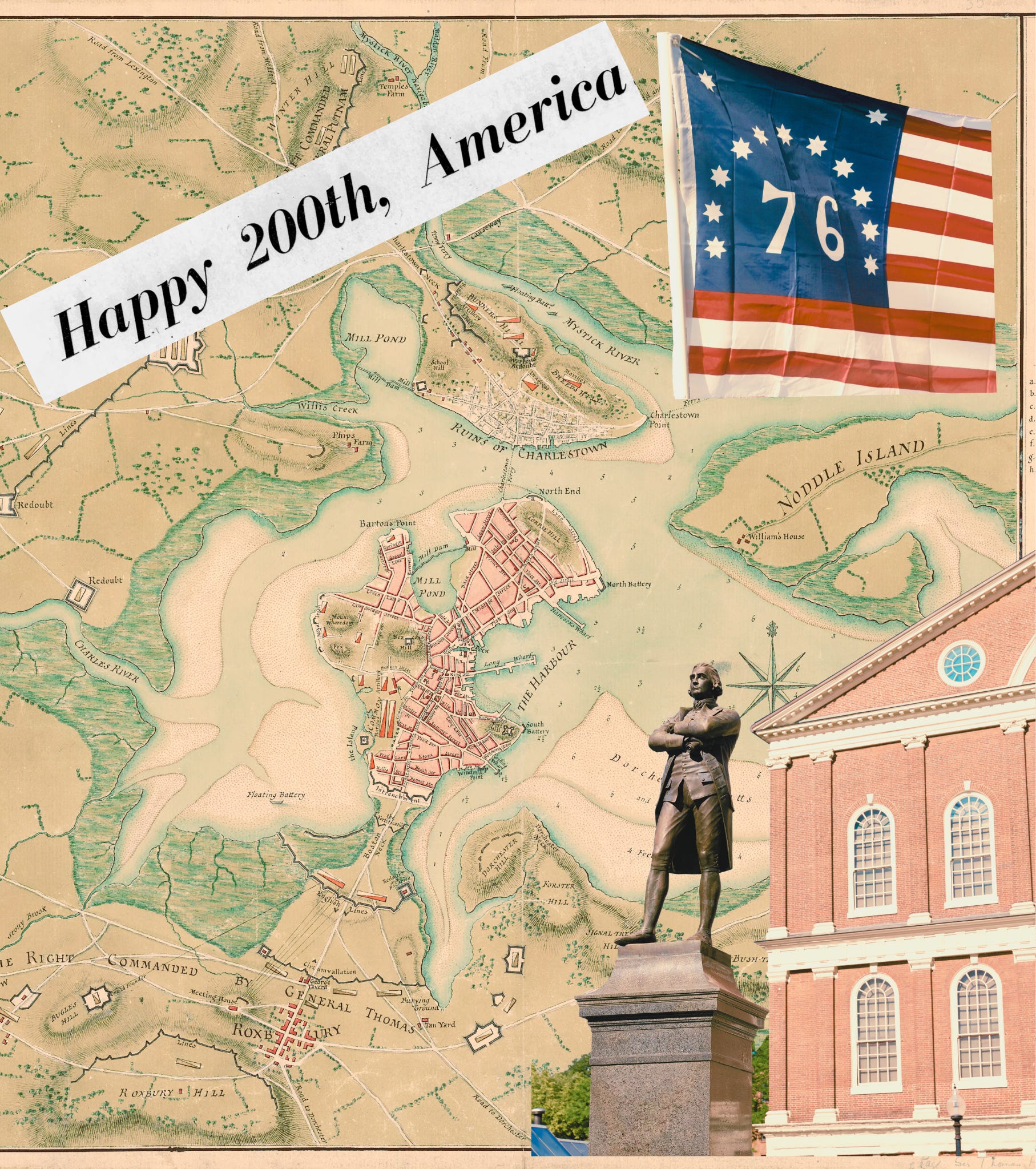
July 4, 1976. Americans were celebrating the 200th anniversary of the signing of the Declaration of Independence, a moment heavy with symbolism for a country still stitching itself together after Vietnam and Watergate. The Bicentennial arrived on a Sunday, turning the holiday into a full‑weekend expression of national pride. And people embraced it.
On July 3rd, half a million people crowded into Washington, D.C. for the American Bicentennial Grand Parade, a spectacle of marching bands, floats, and flags that tried to capture the spirit of a nation rediscovering its confidence. It was the kind of weekend when everything felt wrapped in red, white, and blue, including the game that has always claimed a piece of America’s soul.
Unfortunately, the National Pastime was absent from our Nation’s Capital, a particularly unfortunate event created by the departure of the Washington Senators in 1971 that would not be remedied until the arrival of the Nationals in 2005. And baseball fans in Boston, home to the Boston Tea Party, Paul Revere, and the shadow of Lexington and Concord could only watch their team from afar as they spent the holiday weekend playing in Milwaukee. Even the home of the Boston Massacre, one of the sparks that lit the flame of the Revolution, couldn’t mark the Bicentennial by gathering at Fenway to watch America’s greatest creation. The irony was hard to miss.
Boston entered the weekend with an uneasy backdrop. Just two days earlier, a string of overnight bombings, from a National Guard armory in Dorchester to a courthouse in Newburyport and even a post office across the New Hampshire border, had rattled the region. No one was injured, but the blasts cast a shadow over a city already strained by the court‑ordered busing crisis, which had divided neighborhoods, inflamed racial tensions, and made even routine civic events feel fraught. Boston was preparing to celebrate the nation’s 200th birthday while still struggling to hold itself together.
Still, the city pressed forward. Boston had a full slate of festivities planned for the day, starting with a parade near City Hall and Faneuil Hall at 8 AM and ending with fireworks over Dorchester Bay at 10 PM. It was also predicted to be a perfect sunny, 80-degree New England summer day.
The Bicentennial represented a chance to come together, even if only for a day, to celebrate the city and its role in the American Revolution. The Boston Globe estimated that 200,000 people would end the night watching fireworks. The Red Sox were set to begin play at 3:00 PM eastern time, providing the perfect way to spend the afternoon before heading out for that evening’s festivities.
The Boston Globe also undertook an imaginative exercise for the occasion, printing a fictional newspaper dated July 5, 2076. Since July 4th will again fall on a Saturday in 2076, the Globe chose to create a mock Sunday edition for July 5th, providing a glimpse at what life in Boston, and America, might look like three centuries after the Revolution.
And well, some of its predictions are interesting. Here are some highlights:
On July 3rd, the United States Senate voted to reduce the maximum work week from 25 hours to 20 hours. It was the fourth such decrease since the maximum work week was created in the 2020s. Time is ticking on this prediction.
Tension had built up under Los Angeles, signaling a possible earthquake. However, tension relieving technology would be deployed to avert that outcome.
The Red Sox would have a female pitcher and a minor league affiliate in Kyoto, Japan.
Marriages were temporary in nature, and couples signed a temporary marriage contracts.
The last gas-powered Cadillac was a model year 1999. This one has already been proven false.
America would celebrate its 300th anniversary with a female President, who will be 86 years old. At least the idea of octogenarian Presidents, unheard of in 1976, has come true.
And so, with the city celebrating, divided, anxious, and hopeful all at once, Boston baseball fans turned to the one constant they could count on: the Red Sox, playing far from home on America’s 200th birthday. The Red Sox had entered the season as the defending American League Champions, having lost the World Series to the Cincinnati Reds.
The 1976 Red Sox had failed to meet the lofty standards of their predecessors, entering the game at 35-37. The team still had fan favorites like Fred Lynn, Carl Yastrzemski, Carlton Fisk, Dwight Evans, Luis Tiant, and Rico Petrocelli. Bill Lee was also there but was sidelined by an injury early in the season.
The team had underachieved to that point, putting pressure on manager Darrell Johnson, who appeared to have lost the confidence of the clubhouse. They were in fourth place, 10 games behind the New York Yankees. The odds of a repeat appearance in the World Series were almost certainly diminished.
But the Red Sox had an opportunity to celebrate July 4th with a win. Luckily, they were playing a team having an even worse season. The Brewers entered the day with a 27-42 record. This was the final game of a four-game series, during which the Brewers had won two out of the three. The Red Sox needed a win to avoid the series loss.
But before we get there, it’s worth remembering what else was running through the background of that Bicentennial Sunday. If you were out for a morning errand, driving home from a cookout, or just letting the radio play while you got ready for the fireworks, you may have heard these songs, the top 5 in the nation:
“Afternoon Delight” by Starland Vocal Band
“Silly Love Songs” by Paul McCartney & Wings
“More, More, More” by Andrea True Connection
“Kiss and Say Goodbye” by The Manhattans
“Misty Blue” by Dorothy Moore
I could not find a reliable source for box office numbers, except that the Richard Donner’s horror film, The Omen, was #1.
Rick Wise took the mound for the Red Sox, opposite Pete Broberg of the Brewers. The Red Sox jumped on top early with a Fred Lynn double that scored Cecil Cooper, who had reached first to start the game with a walk. The Brewers answered back in the bottom of the inning, when Mike Hegen hit a single to left field that scored former Red Sox George Scott. The game remained tied until the top of the fifth inning when Cecil Cooper hit a two-run home run for the final score of the game to put the Red Sox on top, 3-1.
After giving up a run in the first, Wise settled in and only gave up two hits for the rest of the game. It was another win in a dominant streak for Wise, who had now pitched to a 2.37 ERA in his last five starts, including a 3-0 win over the Baltimore Orioles in his last start that was a perfect game until the sixth inning. Unfortunately for Wise, he could not keep the good times rolling and posted a 6.04 ERA over his next five starts.
But the calm of July 4th wouldn’t last. The coming weeks would reshape the franchise. Team owner Tom Yawkey passed away on July 8, ending an ownership tenure that stretched back to 1933. Less than two weeks later, on July 19, Darrell Johnson was dismissed, an abrupt end for a manager who had taken the Red Sox to the World Series just the year before. The Bicentennial weekend offered a brief moment of stability, but only briefly.
In the end, the Red Sox offered Boston a small but welcome moment of steadiness on a day defined by history, celebration, and uncertainty. While the city looked back across two centuries and imagined what the next hundred years might bring, the team delivered a simple, satisfying victory, nothing dramatic, nothing historic, just a clean 3–1 win to carry fans into the evening’s fireworks. As it has for much of our country’s history, baseball offered a sense of comfort and familiarity.
It was proof that on America’s 200th birthday, the game that has shadowed the nation’s history could still offer a few hours of calm, connection, and continuity.