
July 13, 1999
As the All-Star Game Arrives in Boston, Fenway Park Prepares to Say Goodbye

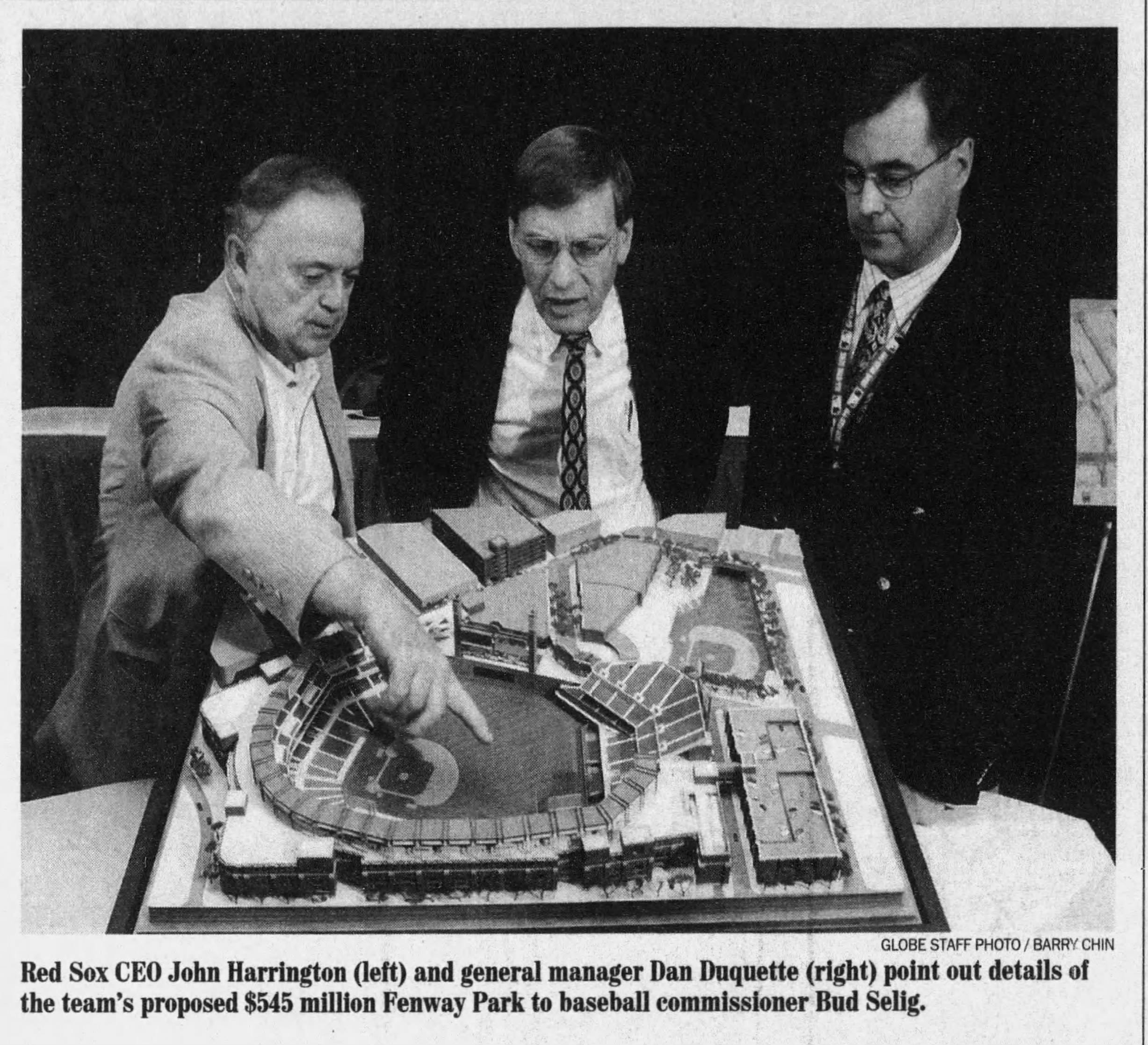
July 13, 1999. The MLB All-Star Game had arrived in Boston for the first time since 1961 and it was a celebration that carried extra significance. At the time, it was thought to be the last hurrah for the old ballpark. Red Sox CEO John Harrington had announced that a new Fenway Park was to be built adjacent to the current structure at the cost of $550 million. The decision immediately drew the ire of community groups, who rallied to save Fenway Park. As the All-Star Game came to town, the success of those endeavors was still uncertain.
Readers of the Boston Globe were also greeted with a news story that may have carried little significance to the day’s festivities, at least at first blush. On the front page was the story of the New York Times Company, the then-parent company of the Globe replacing publisher Benjamin Taylor with Richard Gilman, senior vice president of operations at the New York Times. The decision marked the end of 126 years of control by the Taylor family. In any other summer, it might have been a footnote. But with Fenway Park, built by John I. Taylor, son of Globe publisher Charles H. Taylor and grandfather of Benjamin, facing demolition, the news felt like connected to the greater sense of transition enveloping the city as it prepared to transition into the 21st century. The Globe printed a glowing tribute to the Taylor family and their legacy in Boston. It was the end of an era.
Vice President Al Gore had visited Boston on the previous day, denouncing Texas Governor George W. Bush’s stance on gun control in a speech in front of the Boston Police Headquarters in Roxbury. Gore was the frontrunner for the Democratic Party’s nomination in the 2000 Presidential election while Bush led in the polls for the Republican Party. During his visit to Boston, Gore received a Fenway Park t-shirt from Mayor Thomas Menino, which was a present to Gore’s grandson, who had been born on July 4th.
The All-Star festivities kicked off the night before with the Home Run Derby, a particularly amazing spectacle in an era where towering home runs were the norm. And it did not disappoint. Mark McGwire of the St. Louis Cardinals put on a show in the first round, hitting 13 home runs, including one that sailed 488 feet. The average for McGwire’s first round was an astounding 438 feet. This was expected from McGwire, who was less than a year removed from joining Sammy Sosa of the Chicago Cubs in a captivating home run chase that saw both men chase the then-record of 61 home runs in a single season set by Roger Maris of the New York Yankees in 1961. Both men surpassed the record, and McGwire set the new mark at 70.
In those days, there were no seats on the Green Monster, only a net. Fans gathered behind the Monster, on Lansdowne Street, in hopes of catching one of the monstrous home runs that sailed over it. As it often is during Red Sox games, Lansdowne was closed to vehicular traffic, making it prime real estate for anyone who could not get a ticket to the Home Run Derby. Red Sox fans showed up to support Nomar Garciaparra of the home team and hometown kid Jeff Bagwell of the Houston Astros. Bagwell had been part of the Red Sox farm system until a particularly disastrous 1990 trade that sent him to Houston for Larry Andersen.
Nomar failed to advance past the first round, hitting just two home runs. He was joined in elimination by Sammy Sosa who managed just one. Bagwell placed in the top four, along with McGwire, Jeromy Burnitz of the Milwaukee Brewers, and Ken Griffey Jr. of the Seattle Mariners. Griffey had barely made it, hitting just three home runs in the first round.
On this night, consistency won over spectacle. McGwire only hit 3 home runs in the second round while Griffey surged to 10 to win his spot in the final round. Bagwell hit just a single home run and was eliminated. Griffey was joined in the finals by Burnitz, who hit 6 home runs. Griffey won the Home Run Derby by just a single home run, 3 to Burnitz’s 2. McGwire and Griffey had hit the same total, but Griffey hit his home runs at the right time.
It was a perfect warmup for the main festivities, an electric way to prime fans for an All-Star Game that would be started by Pedro Martínez of the Boston Red Sox. As far as the fans of the day were concerned, it was to be the start of the last hurrah for Fenway Park.
Fans could have started their day at the John Hancock All-Star Fan Fest at the Hynes Convention Center, which ran from 8 a.m. to 5 p.m. If they made their visit early in the day, they may have had time to head down to the movie theater to watch one of these films, the top 5 films from this week in 1999:
American Pie
Wild Wild West
Big Daddy
Tarzan
Star Wars: Episode I – The Phantom Menace
After going to the theater, you might have listened to one of these songs on your portable radio as you made your way to the ballpark:
“If You Had My Love” by Jennifer Lopez
“Bills, Bills, Bills” by Destiny’s Child
“Last Kiss” by Pearl Jam
“Livin’ La Vida Loca” by Ricky Martin
“It’s Not Right But It’s Okay” by Whitney Houston
If you were not fortunate enough to make it to the ballpark, you could have watched the game with your fellow Red Sox fans at a showing held by Mayor Menino in City Hall Plaza.
The festivities began with an unveiling of the nominees to the All-Century Team by Kevin Costner, which included men like Hank Aaron, Carl Yastrzemski, Carlton Fisk, Willie Mays, and of course, the Splendid Splinter himself Ted Williams. Williams’s introduction stole the show as he made his way onto the field in a golf cart. American and National League players crowded around the living legend, hoping to get a moment with the greatest hitter of all-time. Williams tipped his hat to the crowd, something he refused to do during his playing days, and threw out the first pitch to kick off the game. It was an emotional moment and a fitting tribute to one of the all-time greats.
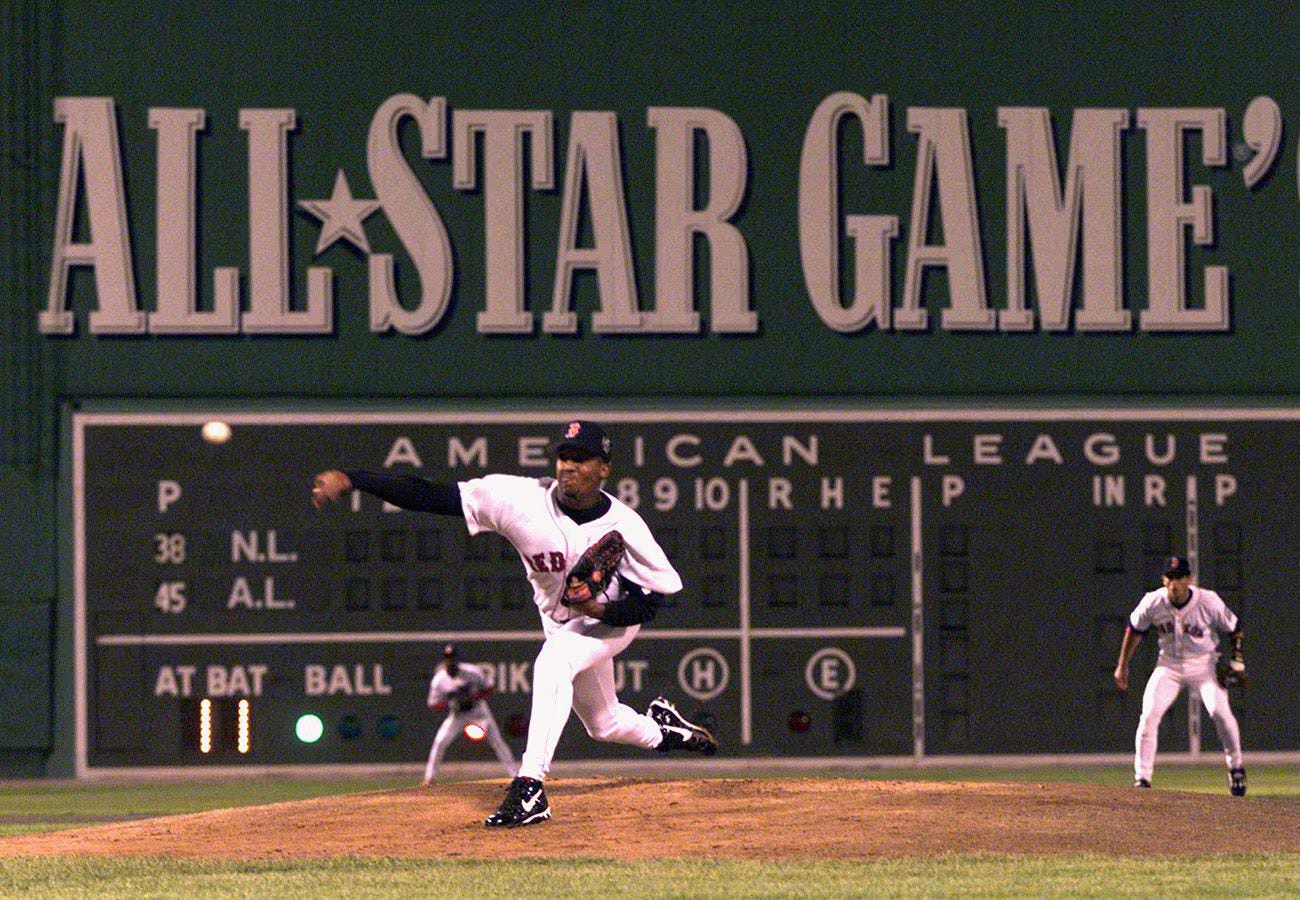
During an era that was dominated by gargantuan home runs and incredible feats of strength, Pedro Martinez took to the mound and reminded the world of the dominance that a pitcher could still exert. Martinez struck out the first four batters he faced, which included McGwire and Sosa. In the process, he became the first pitcher to start an All-Star Game by striking out the side and setting a new consecutive strikeout record to start an All-Star Game in the process. Of the six batters he faced, he struck out five.
Nomar Garciaparra joined Pedro as an American League starter, taking his place at shortstop. Garciaparra was less impressive, failing to reach base in his two at-bats. The National League was held to just one run, which came off the bat of Barry Larkin of the Cincinnati Reds in the third inning with a hit that scored Burnitz from second.
The American League jumped to an early 2-0 lead with back-to-back run scoring singles by Jim Thome of the Cleveland Indians and Cal Ripken Jr. of the Baltimore Orioles off of National League starter Curt Schilling of the Philadelphia Phillies. The American League ultimately won 4-1.
In perhaps the biggest irony of an All-Star Game held during the height of inflated home run numbers is the fact that not a single home run was hit. The scoring happened off of base hits and in one case, an error.
For his part, Martinez won the All-Star Game MVP award. The other Red Sox to appear in the game, Jose Offerman had just one at-bat, a groundout in the sixth inning that moved Dartmouth College alumnus Brad Ausmus of the Detroit Tigers to second base.
In the days leading up to the game, CNN Sports Illustrated offered up the following thoughts:
The oldest park in baseball is due for demolition. Although the Red Sox are still working on plans for a replacement, and community groups are fighting those plans, it's safe to say that the last All-Star game of the century will be the last one at Fenway as well.
While the All-Star Game has yet to return to Fenway Park, the ballpark has survived. It was saved when John W. Henry and his business partners purchased the team in 2002. Hundreds of millions of dollars later and Fenway Park continues to stand as the venerable cathedral of baseball.
It is not often in life that goodbyes are rescinded, but we can all be happy that this one was.