
August 31, 1913
“Why Are You a Baseball Fan?”: A Day Without Boston Baseball Still Had Baseball Everywhere

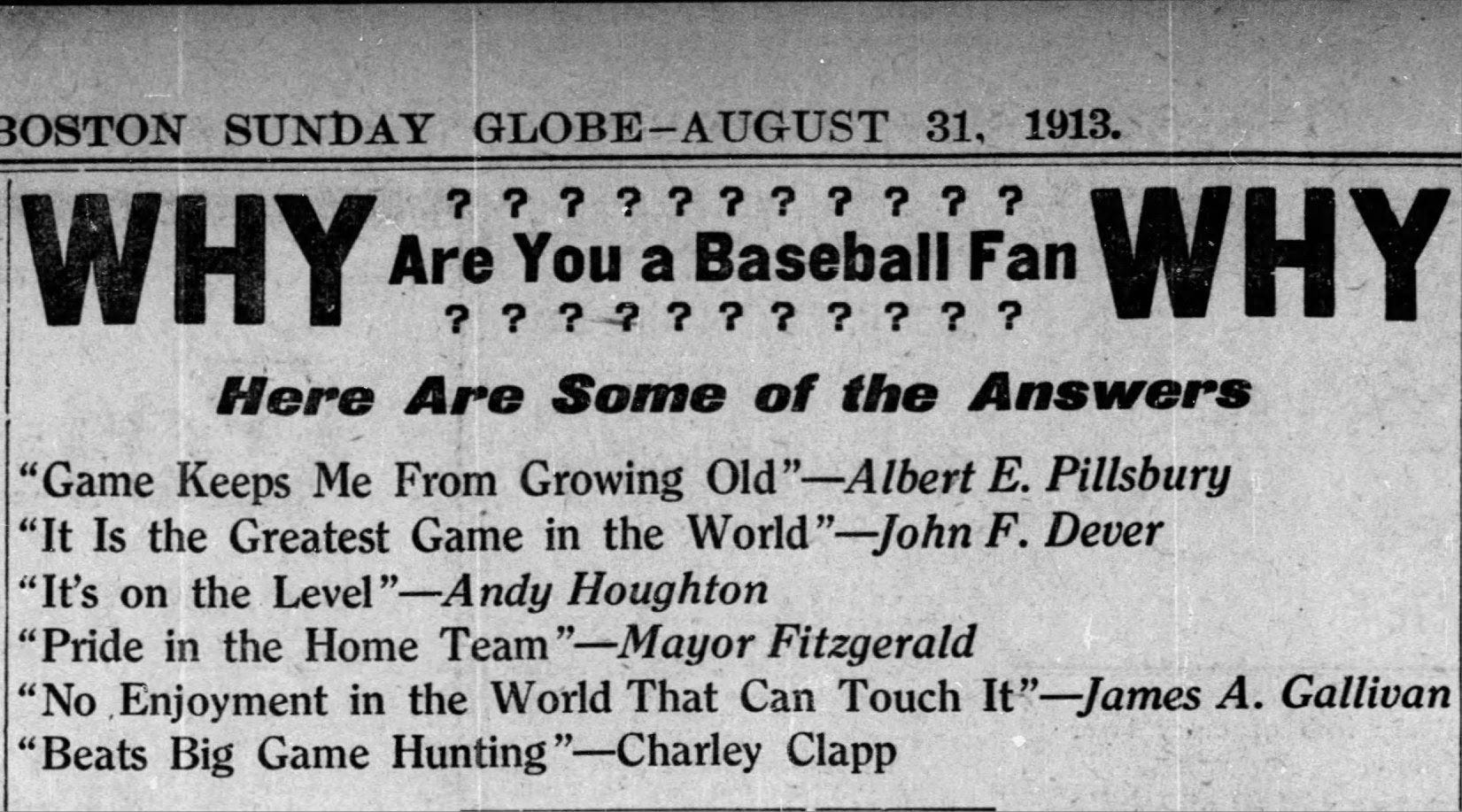
August 31, 1913. On this date, the Boston Globe asked a simple question: “Why are you a baseball fan?” It’s a timeless question, though it was an interesting time in Boston to ask it. Despite winning the World Series in 1912, the Red Sox had regressed significantly and were sitting under .500. The Braves hadn’t posted a winning season since 1902, so their struggles were expected. The Red Sox were dealing with the harsh reality that success in baseball can be fleeting.
Just ten months earlier, Boston had celebrated one of the greatest seasons the city had ever seen. The Red Sox had opened Fenway Park, won 105 games, and captured the World Series in dramatic fashion. They had stars like Tris Speaker, Harry Hooper, and Duffy Lewis, while Smoky Joe Wood’s legendary 34-win season had made him one of the biggest names in the sport.
The American League belonged to Connie Mack’s Philadelphia Athletics, who were seven games ahead of the Cleveland Indians. The Red Sox were sitting fifth in the American League at 59-61. The New York Yankees, in their first season with that name, were dead last at 42-77. The National League belonged to the other team that called the Polo Grounds home, the New York Giants, so it was not all gloom in New York City. The second-place team was the Philadelphia Phillies, but they were nine games back. Given the margin, an all-Philadelphia World Series was virtually impossible.
What makes this post unique is that neither Boston team played on August 31, 1913. In a way, that makes it an even better example of baseball’s role in the collective consciousness, especially during the dog days of summer.
Both Boston teams were taking a break between doubleheaders. The Red Sox had just lost two to the Washington Senators and were awaiting the Yankees for a Labor Day doubleheader at Fenway. The Braves were in New York, having just won two against the Brooklyn Dodgers and were taking a break before heading to Manhattan to play the New York Giants.
The Boston Globe carried coverage of a “county fair” arranged by St. Ann’s Parish in Somerville and, of course, baseball was on the agenda. In the morning, the sanctuary choir boys defeated the altar boys, 10-7. The ladies of the parish also played a baseball game, arranging themselves into two teams, the Red Sox and White Sox. The Red Sox won, 23-15 in a game that was called after five innings.
The Globe also carried an article regarding the invention of the various sports popular around the country at the time. The article contended that baseball held “undisputed sway as the American National Game” and discussed how it evolved from the old English game of Rounders. It also contended that basketball is unique in having not evolved from an older game, but being rather invented by a single man, James Naismith just over two decades prior.
There was also a brief mention of a baseball game between the police departments of Boston’s Metropolitan Park Commission and the City of Lowell with the Boston team coming out on top to win the Police Championship.
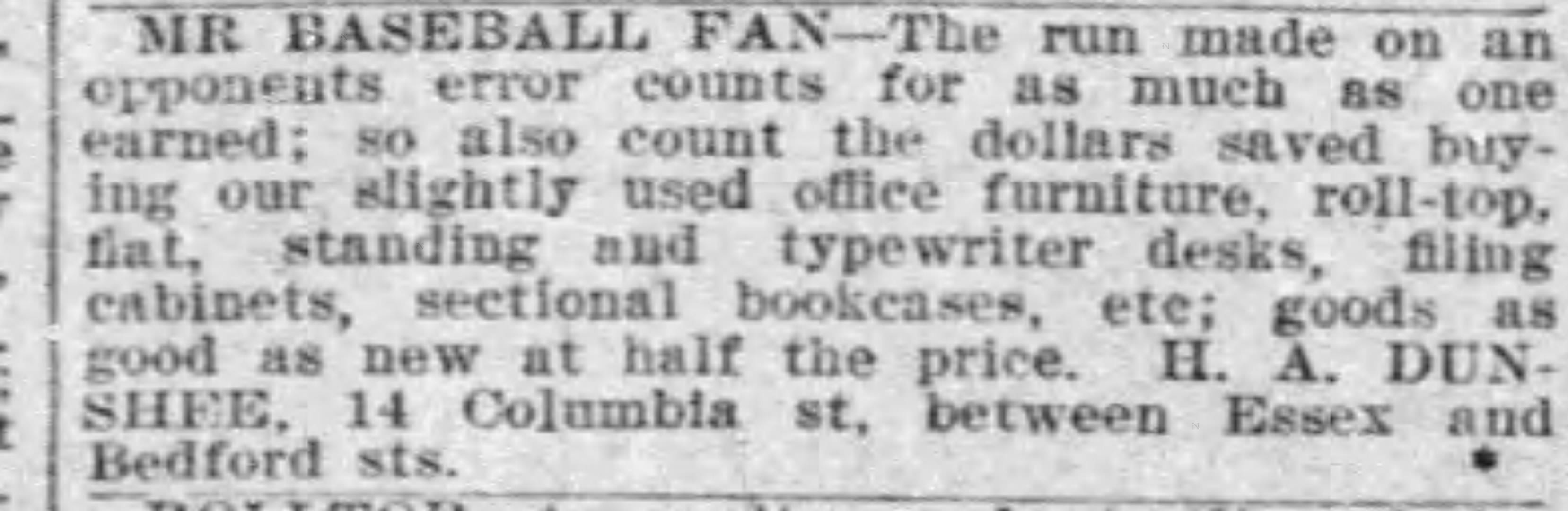
And well, baseball was also used by advertisers as a means of relating to customers, as seen below:
There was also coverage of President Woodrow Wilson’s stay at his summer home in Cornish, New Hampshire where he was receiving updates about the ongoing Mexican Revolution. The President had advised American citizens in Mexico to leave the country due to escalating violence. President Wilson did not recognize the then-current regime leading Mexico, which had come into power just months earlier in a military coup. House Speaker Champ Clark was asked about the possibility of war with Mexico while campaigning in Maine for Democratic House candidate William Pattangall. The Speaker denied that a war would happen.
Speaking of war, the Globe was also carrying a day-by-day feature of the happenings of the American Civil War, just fifty years prior. On this day, the sinking of a Union warship by the Confederates on August 31, 1863, was discussed.
Much space was also dedicated to discussing the plight of Harry Thaw, an escaped convict who had escaped New York’s Matteawan State Hospital for the Criminally Insane and fled to Sherbrooke, Quebec, Canada, not far from the border with New Hampshire and Vermont. Thaw had been convicted but found insane after the murder of Stanford White in 1906. Much as would happen today, because the crime involved two wealthy men, it attracted intense media attention. The misadventures of the rich and famous have always captivated our society. Thaw was eventually deported back to the United States.
I do not have popular movies or music for this week in 1913, but I do have movie related news. In the days leading up to August 31st, there had been talk of a strike at Boston’s movie and vaudeville theaters. On this day, Bostonians breathed a sigh of relief as a strike was averted.
It was just another late summer day in Boston. Presidents worried about foreign crises. Newspapers remembered a war that had nearly destroyed the nation. The public followed the scandals of the rich and famous. Workers debated their rights. Families looked for entertainment.
And through all of it, baseball was there.
The Globe’s question on August 31, 1913, was simple: “Why are you a baseball fan?”
It’s a question that we still answer to this day. That is the beauty of baseball. Everyone has their own reason for loving it, but no matter the reason, the game is always there.
Baseball is the backdrop against which history happens.