
April 14, 1978
One Friday in April: Opening Day in the Upper Valley

April 14, 1978. Opening Day — the favorite day of the year for baseball fans across the country. It’s a day when hope begins anew. Every team enters in the same position, and anyone could win it all! In theory, at least.
If your team begins on the road, as the Red Sox often do, your Opening Day experience is shaped by the outcome of that road trip. 1978 was no different. The Boston Red Sox started the season on the shores of the Great Lakes, playing the Chicago White Sox and Cleveland Indians. They won two of the five games. Not the worst start.
Fans in the Upper Valley of New Hampshire and Vermont, roughly two hours north of Boston, may have headed down to Fenway, watched from home, or listened on the radio. Before any of that, though, they would have woken up, picked up the Valley News, and read the headlines of the day. In national news, Ted Kennedy was denying any interest in running for President against incumbent Jimmy Carter in 1980. Of course, we all know how that ended up.
1976 Presidential candidate Ronald Reagan was fined $30,000 for exceeding the spending limit in the New Hampshire primary. The Federal Elections Commission found that Reagan had unintentionally exceeded the limit by 15 percent. The spending limit had been put in place to fight corruption after the Watergate scandal.
In local (and somewhat confusing) news, the Village of Woodstock, Vermont was seeking reimbursement for police services provided to the Town of Woodstock, Vermont. The Village is essentially the downtown area of the Town. However, the Village had a full-time police force while the Town did not. The relationship between the two entities was at least cordial and there was no animus involved. One guy, Robert Horne, even shared the title of Town and Village Manager. The two “sides” came to an agreement where the Village trustees would provide a per-hour rate to the Town Selectmen for police services.
Students and parents in Hanover and Norwich were meanwhile dealing with a school controversy involving Superintendent Ray Edwards, whose management of the bistate district had drawn criticism over finances and governance. Letters calling for his resignation had begun appearing in the Valley News, a wish that was granted on June 30th when Edwards departed for a job in Pittsburgh, Pennsylvania.
That April 14th did bring some good news. Students in Hanover learned that they did not have to make up a day lost to a big February snowstorm. Since the school district had scheduled the makeup day for a Saturday, this represented a huge victory.
The Valley News offered a preview of the Red Sox home opener alongside stories about local high school baseball. One article previewed an upcoming May game between the high schools in Claremont and Keene, New Hampshire. Another recapped a game between the high schools in Hartford and Springfield, Vermont. A schedule on the sports page mentioned the upcoming Dartmouth-Harvard game in Hanover. As the Express and Standard in Newport, Vermont printed on April 2, 1878, over 100 years prior, “Base-ball clubs are agitating the youthful mind.” In 1978, that was still true.
For families who were driving down to the Red Sox game, they might have turned on the radio and heard these songs, the top five songs for the week of April 15th:
After the game, they may have gone to see one of the top 5 movies from that week in 1978:
The Fury
Saturday Night Fever
American Hot Wax
The Goodbye Girl
Close Encounters of the Third Kind
People who stayed local in the Upper Valley could have gone back in time to 1940 to watch the Cary Grant and Katharine Hepburn classic “The Philadelphia Story,” which played that night in Spaulding Auditorium at the Hopkins Center at Dartmouth.
That summer, a movie based on the experiences of a Dartmouth College student, Animal House, would hit the theaters.
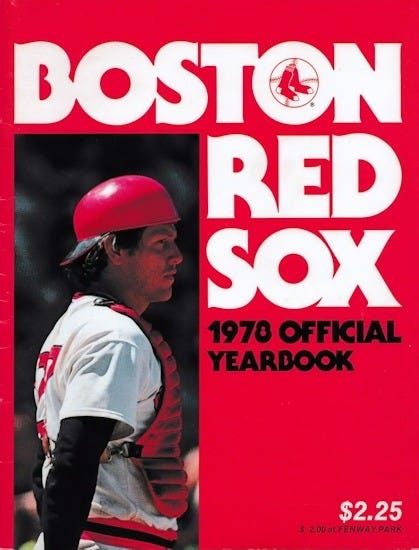
A trip down to Boston would have been a break from the chilly New Hampshire and Vermont weather. The high in the Upper Valley that day was near 40 degrees and the low was near 20. Scattered showers and flurries hit the area overnight.
Meanwhile, fans in Boston took their seats on a beautiful 60 degree day. The ceremonial first pitch was thrown by Duffy Lewis, a star of the early twentieth century and a central figure in the club’s first great dynasty. In 1912, during Fenway’s inaugural season, Lewis had made left field his domain, playing the strange embankment at the base of the wall so well that it came to be known as “Duffy’s Cliff.”
At 2:15 p.m. Dennis Eckersley, newly arrived from Cleveland, took the mound for his first start in Boston. He was not the only new face. His future NESN colleague Jerry Remy, newly acquired from the California Angels, made his debut as well. The opponent, the Texas Rangers, arrived with the same 2–3 record as Boston.
The game itself came in bursts. A home run by Fred Lynn in the fourth put Boston on the board, though they still trailed. In the seventh, George Scott drove in Carlton Fisk to tie it, a moment that briefly lifted the afternoon before Texas answered again.
In the eighth inning, the Red Sox found another opening. Butch Hobson homered, and a single from Jim Rice brought Remy home to tie the game once more. The game moved into extra innings.
There was a moment, in the top of the tenth, when the day might have turned. Eckersley, still on the mound, allowed two runners to reach with two outs. Manager Don Zimmer turned to Don Drago, who immediately threw a wild pitch, pushing both runners into scoring position. For an instant, the afternoon hung in the balance. Then Drago recovered, striking out the final batter and keeping the game alive.
In the bottom of the inning, Rice ended it with a single that brought the winning run home.
The season that followed would be remembered for the collapse and the loss to the New York Yankees that still lingers in memory. But on that afternoon, none of that had happened yet. The Red Sox had won. The crowd went home satisfied.
The heartbreak that lay ahead did not matter. Sometimes ignorance is bliss.